| 中國哲學書電子化計劃 |
《唐王秉誠修大會 觀音顯聖化金蟬》 | 英文翻譯:人工智能和中國哲學書電子化計劃用戶 [?] | 電子圖書館 |
| 1 | 唐王秉誠... : | 卻說鬼使同劉全夫妻二人出了陰司,那陰風遶遶,徑到了長安大國,將劉全的魂靈推入金亭館裡,將翠蓮的靈魂帶進皇宮內院。只見那玉英宮主正在花陰下,徐步綠苔而行,被鬼使撲個滿懷,推倒在地,活捉了他魂,卻將翠蓮的魂靈推入玉英身內。鬼使回轉陰司不題。 |
| Now, the ghost messenger led Liu Quan and his wife out of the Underworld. The cold wind swirling around them took them directly to Chang'an Da Guo (the Great Country of Chang'an). They pushed Liu Quan's soul into Jin Ting Guan, and brought Cui Lian's spirit into the inner courtyard of the imperial palace. They saw that Yuying Gongzhu was walking slowly on the green moss in the shade of flowers when the ghost messenger suddenly pounced upon her, knocking her to the ground. He seized her soul and pushed Cui Lian's spirit inside Yuying's body. The ghost messenger returned to the Underworld; no more is said about him. | ||
| 2 | 唐王秉誠... : | 卻說宮院中的大小侍婢見玉英跌死,急走金鑾殿,報與三宮皇后道:「宮主娘娘跌死也。」皇后大驚,隨報太宗。太宗聞言,點頭嘆曰:「此事信有之也。朕曾問十代閻君:『老幼安乎?』他道:『俱安,但恐御妹壽促。』果中其言。」合宮人都來悲切,盡到花陰下看時,只見那宮主微微有氣。唐王道:「莫哭!莫哭!休驚了他。」遂上前將御手扶起頭來,叫道:「御妹甦醒甦醒。」那宮主忽的翻身,叫:「丈夫慢行,等我一等。」太宗道:「御妹,是我等在此。」宮主擡頭睜眼觀看道:「你是誰人,敢來扯我?」太宗道:「是你皇兄、皇嫂。」宮主道:「我那裡得個甚麼皇兄、皇嫂?我娘家姓李,我的乳名喚做李翠蓮,我丈夫姓劉名全,兩口兒都是均州人氏。因為我三個月前拔金釵在門首齋僧,我丈夫怪我擅出內門,不遵婦道,罵了我幾句,是我氣塞胸堂,將白綾帶懸梁縊死,撇下一雙兒女,晝夜悲啼。今因我V夫被唐王欽差,赴陰司進瓜果,閻王憐憫,放我夫妻回來。他在前走,因我來遲,趕不上他,我絆了一跌。你等無禮!不知姓名,怎敢扯我?」太宗聞言,與眾宮人道:「想是御妹跌昏了,胡說哩。」傳旨教太醫院進湯藥,將玉英扶入宮中。 |
| Now, the maidservants of all ranks in the palace courtyard saw that Yuying had fallen and died. They hurried to Jinluan Hall and reported to the Empress Dowager of the Three Palaces: "The Palace Mistress Lady has fallen and died." The empress dowager was greatly shocked, and immediately informed Emperor Taizong. Emperor Taizong nodded upon hearing this and sighed, "This matter is indeed true. I once asked the Ten Generations of Yan Jun: 'Are the young and old at peace?' He said, "They are all safe, but I fear your imperial sister's life is short." Indeed, his words have come true." Everyone in the palace was filled with sorrow and grief. They all went to look under the shade of the flowers, only to see that the Palace Mistress still had a faint breath left. Emperor Tang said, "Do not weep! Do not weep! Don't startle her." He then stepped forward and used his imperial hands to lift her head, calling out, "Imperial sister, awaken! Awaken!" The Palace Mistress suddenly turned over and said: "Husband, walk slowly—wait for me a while." Emperor Taizong replied, "Imperial sister, it is we who are here." The Palace Mistress raised her head and opened her eyes to look, saying, "Who are you? How dare you pull me?" Emperor Taizong said, "It is your imperial elder brother and empress dowager." The Palace Mistress asked, "Where did I ever get an imperial elder brother or empress dowager?" "My family name is Li, and my childhood name was Li Cui Lian. My husband's surname is Liu and his given name is Quan; the two of us are native to Jun Zhou." Three months ago, I took a golden hairpin and offered alms to monks at the gate. My husband scolded me for leaving the inner gate without permission and violating proper conduct as a wife, cursing me several times. Overcome with anger, I choked on my grief, tied a white silk ribbon around my neck, and hanged myself from the beam, leaving behind a pair of children who have cried day and night. Now, because my husband was commissioned by Emperor Tang to go to the Underworld with melons and fruits, King Yan took pity on us and allowed our return. He walked ahead, and because I was late, I could not catch up with him; I stumbled and fell. You are being disrespectful! "You do not know my name, yet how dare you pull me?" Upon hearing this, Emperor Taizong said to the palace attendants, "It must be that my imperial sister fainted from the fall and is speaking nonsense." He issued an order for the Imperial Medical Office to prepare soup medicine, and had Yuying assisted into the palace. | ||
| 3 | 唐王秉誠... : | 唐王當殿,忽有當駕官奏道:「萬歲,今有進瓜果人劉全還魂,在朝門外等旨。」唐王大驚,急傳旨,將劉全召進,俯伏丹墀。太宗問道:「進瓜果之事何如?」劉全道:「臣頂瓜果,徑至鬼門關,引上森羅殿,見了那十代閻君,將瓜果奉上,備言我王慇懃致謝之意。閻君甚喜,多多拜上我王道:『真是個有信有德的太宗皇帝!』」唐王道:「你在陰司見些甚麼來?」劉全道:「臣不曾遠行,沒見甚的,只聞得閻王問臣鄉貫、姓名。臣將棄家捨子,因妻縊死,願來進瓜之事,說了一遍。他急差鬼使,引過我妻,就在森羅殿下相會。一壁廂又檢看死生文簿,說我夫妻都有登仙之壽,便差鬼使送回。臣在前走,我妻後行,幸得還魂。但不知妻投何所。」唐王驚問道:「那閻王可曾說你妻甚麼?」劉全道:「閻王不曾說甚麼,只聽得鬼使說:『李翠蓮歸陰日久,屍首無存。』閻王道:『唐御妹李玉英今該促死,教翠蓮即借玉英屍還魂去罷。』臣不知『唐御妹』是甚地方,家居何處,我還未曾得去找尋哩。」 |
| While Emperor Taizong was in the hall, a court official suddenly reported, "Your Majesty, Liu Quan, who went to offer melons and fruits to the Underworld, has returned to life. He is waiting for an audience at the palace gate." Emperor Taizong was greatly surprised and immediately issued a decree to summon Liu Quan inside. Liu Quan knelt prostrate on the red-tiled courtyard. Emperor Taizong asked, "How did the matter of offering melons and fruits go?" Liu Quan replied, "I carried the melons and fruits directly to the Gate of Ghosts, passed through the Shiluo Hall, met with the Ten Generations of King Yan, presented the offerings, and conveyed my sovereign's earnest gratitude." King Yan was very pleased and sent many greetings to our king, saying: 'Truly a faithful and virtuous Emperor Taizong!' " Emperor Taizong asked: "What did you see in the Underworld?" Liu Quan said, "I did not travel far and saw nothing remarkable. I only heard King Yan ask me about my native place and name." "I told him the whole story of how I left home and children behind, that my wife had hanged herself, and that I came to offer melons in her memory." He immediately sent a ghost messenger to bring over my wife, and we were reunited right beneath the Shiluo Hall. Meanwhile, they checked the records of life and death and found that both my wife and I were destined to attain immortality. They then sent a ghost messenger to escort us back." "I walked ahead, while my wife followed behind, and we were fortunate enough to return with our souls restored. "But I do not know where my wife was sent." Emperor Taizong inquired with surprise, "Did King Yan say anything about your wife?" Liu Quan replied, "King Yan did not say anything. I only overheard the ghost messenger say: 'Li Cui Lian has been in the Underworld for a long time; her body no longer exists.'" King Yan said, 'The imperial sister Li Yuying of the Tang dynasty is now due to die soon. Let Cui Lian immediately borrow her body and return with a soul.'" "I did not know what 'Tang's imperial sister' refers to, nor where she lives. I have yet to find her." | ||
| 4 | 唐王秉誠... : | 唐王聞奏,滿心歡喜,當對多官道:「朕別閻君,曾問宮中之事。他言:『老幼俱安,但恐御妹壽促。』卻才御妹玉英花陰下跌死,朕急扶看,須臾甦醒,口叫:『丈夫慢行,等我一等。』朕只道是他跌昏了胡言。又問他詳細,他說的話,與劉全一般。」魏徵奏道:「御妹偶爾壽促,少甦醒即說此言,此是劉全妻借屍還魂之事。此事也有,可請宮主出來,看他有甚話說。」唐王道:「朕才命太醫院去進藥,不知何如。」便教妃嬪入宮去請。那宮主在裡面亂嚷道:「我吃甚麼藥?這裡那是我家?我家是清涼瓦屋,不像這個害黃病的房子,花狸狐哨的門扇,放我出去!放我出去!」 |
| Upon hearing the report, Emperor Taizong was overjoyed. He addressed many officials present: "After parting from King Yan, I once asked about matters in the palace." He said: 'The young and old are all safe, but your imperial sister's life may be short.' Just now, my imperial sister Yuying fell and died under the shade of flowers. I hurried to support her, and in a moment she revived, calling out: 'Husband, walk slowly—wait a while for me.' I thought it was just that she had fainted from the fall and was speaking nonsense. But when I asked her in detail, what she said matched exactly with Liu Quan's account." Wei Zheng reported, "The imperial sister's sudden short life span and her immediate mention of these words upon regaining consciousness—this is the case of Liu Quan's wife possessing a body to return with her soul. Such matters do occur. Please bring out the Palace Mistress and see what she has to say." Emperor Taizong said: "I have just ordered the Imperial Medical Office to administer medicine. I do not yet know how she is doing." He then instructed his concubines and attendants to go into the palace and summon her. Inside, the Palace Mistress was shouting in confusion: "What medicine am I supposed to take?" "This place is not my home!" "My home was a cool, tiled house, unlike this sickly yellow-painted building with cat-like and fox-like door panels. Let me out!" "Let me out!" | ||
| 5 | 唐王秉誠... : | 正嚷處,只見四五個女官、兩三個太監扶著他,直至殿上。唐王道:「你可認得你丈夫麼?」玉英道:「說那裡話,我兩個從小兒的結髮夫妻,與他生男育女,怎的不認得?」唐王叫內官攙他下去。那宮主下了寶殿,直至白玉階前,見了劉全,一把扯住道:「丈夫,你往那裡去,就不等我一等?我跌了一跌,被那些沒道理的人圍住我嚷,這是怎的說?」那劉全聽他說的話是妻之言,觀其人非妻之面,不敢相認。唐王道:「這正是山崩地裂有人見,捉生替死卻難逢。」好一個有道的君王,即將御妹的妝奩、衣物、首飾,盡賞賜了劉全,就如陪嫁一般。又賜與他永免差徭的御旨,著他帶領御妹回去。他夫妻兩個便在階前謝了恩,歡歡喜喜還鄉。有詩為證: |
| While she was still shouting, several palace attendants and a couple of eunuchs came in to support her and led her directly onto the hall. Emperor Taizong asked: "Do you recognize your husband?" Yuying replied, "What are you talking about? We have been married since childhood and had children together. How could I not recognize him?" Emperor Taizong ordered the palace attendants to lead her away. The Palace Mistress descended from the dais and went straight to the white jade steps, where she saw Liu Quan. She seized him by the arm and cried, "Husband, where are you going without waiting for me even a little?" "I fell down, and those unreasonable people surrounded me and shouted. What is this all about?" Liu Quan heard her words, which were exactly those of his wife, but saw a face that was not hers. He dared not acknowledge her. Emperor Taizong remarked: "This is indeed the case—when mountains collapse and earth cracks, people may witness it; yet finding a living substitute to die in one's place is truly rare." What a virtuous emperor! He immediately bestowed the imperial sister's cosmetics, clothing, and jewelry upon Liu Quan as if they were dowry items. He also issued an imperial decree exempting Liu Quan from future corvée labor and ordered him to take the former imperial sister back with him. The couple then knelt on the steps to express their gratitude, and returned home joyfully together. There is a poem to attest: | ||
|
人生人死是前緣,短短長長各有年。 劉全進瓜回陽世,借屍還魂李翠蓮。 | ||
| Life and death are fated from before; Long or short, each has its own span. Liu Quan offered melons to the Underworld and returned to this world of life; Borrowing a body, Li Cui Lian regained her soul. | ||
| 6 | 唐王秉誠... : | 他兩個辭了君王,徑來均州城裡,見舊家業、兒女俱好,兩口兒宣揚善果不題。 |
| The two of them bid farewell to the emperor and returned directly to Jun Zhou City. They found their old family estate intact, with their children in good health; the couple then spread tales of their virtuous rewards, but no more is said on this matter. | ||
| 7 | 唐王秉誠... : | 卻說那尉遲恭將金銀一庫,上河南開封府訪看,相良原來賣水為活,同妻張氏在門首販賣烏盆瓦器營生,但賺得些錢兒,只以盤纏為足,其多少齋僧布施,買金銀紙錠,記庫焚燒,故有此善果臻身。陽世間是一條好善的窮漢,那世裡卻是個積玉堆金的長者。尉遲恭將金銀送上他門,諕得那相公、相婆魂飛魄散。又兼有本府官員,茅舍外車馬駢集。那老兩口子如痴如啞,跪在地下,只是磕頭禮拜。尉遲恭道:「老人家請起。我雖是個欽差官,卻齎著我王的金銀送來還你。」他戰兢兢的答道:「小的沒有甚麼金銀放債,如何敢受這不明之財?」尉遲恭道:「我也訪得你是個窮漢,只是你齋僧布施,儘其所用,就買辦金銀紙錠,燒記陰司,陰司裡有你積下的錢鈔。是我太宗皇帝死去三日,還魂復生,曾在那陰司裡借了你一庫金銀,今此照數送還與你。你可一一收下,等我好去回旨。」那相良兩口兒只是朝天禮拜,那裡敢受。道:「小的若受了這些金銀,就死得快了。雖然是燒紙記庫,此乃冥冥之事;況萬歲爺爺那世裡借了金銀,有何憑據?我決不敢受。」尉遲恭道:「陛下說,借你的東西,有崔判官作保可證。你收下罷。」相良道:「就死也是不敢受的。」 |
| Now, regarding General Yuchi Gong: he took a treasury of gold and silver to the Kai Feng Fu in Henan Province for investigation. He found that Zhang Liang had originally made his living by selling water, and together with his wife Zhang Shi, operated at their gate, vending black-glazed clay pots and earthenware for a livelihood. Whatever small profits they earned were enough just for daily expenses; yet they often gave alms to monks, bought paper effigies of gold and silver ingots, recorded them in the treasury, and burned them as offerings—thus reaping this karmic reward. In this world of the living, he was a poor man devoted to doing good; in that other life, however, he became an elder with accumulated wealth. When Yuchi Gong presented the gold and silver at their door, it startled Master Zhang and his wife to such an extent that they were nearly out of their wits. Moreover, with officials from the local government present outside their humble hut and carriages and horses gathered in a crowd, the old couple was stunned into silence, kneeling on the ground and bowing repeatedly without ceasing. Yuchi Gong said, "Elders, please rise. Though I am an imperial envoy, I have brought this gold and silver from our king to return it to you." Trembling with fear, he replied, "I have no gold or silver lent out as debt. How dare I accept such unearned wealth?" Yuchi Gong said, "I have investigated and found you to be a poor man. Yet because you gave alms to monks and spent all your means on purchasing paper effigies of gold ingots, which you burned as offerings in the Underworld, there is now wealth accumulated for you in the nether realm. It was Emperor Taizong who, after dying for three days and returning to life, had borrowed a treasury of your gold and silver in the Underworld. Now he has sent this back to you according to the original amount." You may receive each item as it is presented, so that I can return with a satisfactory report." The couple Zhang Liang and his wife could only bow to the heavens in reverence, too frightened to accept. They said, "If I were to accept this gold and silver, I would die quickly. Though it is true that burning paper effigies in the Underworld records wealth—this is a matter of unseen forces; Moreover, how can we know for certain that His Majesty borrowed gold and silver in that other world? What proof do we have?" I dare not accept it." Yuchi Gong said, "The Emperor says that when he borrowed your belongings, there was Master Cui as a guarantor to serve as evidence. "You must take them," Zhang Liang replied, "Even if I were to die, I still dare not accept them." | ||
| 8 | 唐王秉誠... : | 尉遲恭見他苦苦推辭,只得具本差人啟奏。太宗見了本,知相良不受金銀,道:「此誠為善良長者。」即傳旨教胡敬德將金銀與他修理寺院,起蓋生祠,請僧作善,就當還他一般。旨意到日,敬德望闕謝恩宣旨,眾皆知之。遂將金銀買到城裡軍民無礙的地基一段,周圍有五十畝寬闊,在上興工,起蓋寺院,名「敕建相國寺」,左有相公、相婆的生祠,鐫碑刻石,上寫著「尉遲恭監造」,即今「大相國寺」是也。 |
| Seeing that he persistently refused, Yuchi Gong had no choice but to prepare a report and send someone to present it to the emperor. Emperor Taizong read the report and learned that Zhang Liang refused the gold and silver. He said, "This is indeed a truly virtuous elder." He immediately issued an imperial decree ordering Hu Jingde to use the gold and silver for repairing temples, building shrines in honor of Zhang Liang's virtue, and inviting monks to perform good deeds—thus returning the wealth through these charitable acts. When the decree arrived, Jingde faced the imperial gate in gratitude and announced the edict; all came to know of it. They then purchased a plot of land in the city, fifty mu wide and free from disturbance to soldiers or civilians. Construction began on this site, and they built a temple named "Chiji Xiangguosi" (Imperially Commissioned Xiangguo Temple). To its left stood a shrine honoring Master Zhang and his wife, with inscribed stone tablets recording their virtue. The inscription read: "Supervised by Yuchi Gong." This is the present-day "Da Xiangguo Si." | ||
| 9 | 唐王秉誠... : | 工完回奏,太宗甚喜。卻又聚集多官,出榜招僧,修建水陸大會,超度冥府孤魂。榜行天下,著各處官員推選有道的高僧,上長安做會。那消個月之期,天下多僧俱到。唐王傳旨,著太史丞傅奕選舉高僧,修建佛事。傅奕聞旨,即上疏止浮圖,以言無佛。表曰: |
| After the project was completed and reported back, Emperor Taizong was very pleased. He then gathered many officials, issued a public notice to recruit monks, and organized a grand water-and-land ceremony to deliver the souls of the lost in the Underworld. The decree was posted throughout the land, ordering officials everywhere to recommend virtuous and learned monks to come to Chang'an for the ceremony. Within a month's time, monks from all over the country arrived in great numbers. Emperor Taizong issued an order, instructing Tai Shi Cheng Fu Yi to select virtuous monks and oversee the Buddhist ceremonies. Fu Yi received the decree and immediately submitted a memorial opposing the construction of pagodas, arguing that there was no Buddha. The memorial read: | ||
| 西域之法,無君臣父子,以三塗六道,蒙誘愚蠢。追既往之罪,窺將來之福,口誦梵言,以圖偷免。且生死壽夭,本諸自然;刑德威福,係之人主。今聞俗徒矯託,皆云由佛。自五帝三王,未有佛法,君明臣忠,年祚長久。至漢明帝始立胡神,然惟西域桑門自傳其教。實乃夷犯中國,不足為信。 | ||
| "The teachings from the Western Regions disregard the hierarchy of sovereigns, ministers, fathers, and sons. They propagate the Three Realms and Six Paths, deceiving the ignorant and foolish." "They dwell on past sins, speculate about future blessings, recite foreign words from their mouths, merely to evade deserved punishment." Moreover, birth, death, longevity, and early demise are all matters of nature; punishments, virtues, authority, and blessings depend on the sovereign. Now I hear that vulgar followers falsely claim these matters are determined by Buddhism. Since the Five Emperors and Three Kings, there was no Buddhist law; yet rulers were wise, ministers loyal, and reigns long-lasting. It was not until Emperor Ming of the Han dynasty that foreign deities were introduced; yet it was only the monks from the Western Regions who spread their teachings on their own. This is in fact a foreign intrusion into China, and cannot be trusted. | ||
| 10 | 唐王秉誠... : | 太宗聞言,遂將此表擲付群臣議之。時有宰相蕭瑀,出班俯顖奏曰:「佛法興自屢朝,弘善遏惡,冥助國家,理無廢棄。佛,聖人也。非聖者無法,請寘嚴刑。」傅奕與蕭瑀論辨,言:「禮本於事親事君,而佛背親出家,以匹夫抗天子,以繼禮悖所親。蕭瑀不生於空桑,乃遵無父之教,正所謂非孝者無親。」蕭瑀但合掌曰:「地獄之設,正為是人。」太宗召太僕卿張道源、中書令張士衡,問佛事營福,其應何如。二臣對曰:「佛在清淨仁恕,果正佛空。周武帝以三教分次;大慧禪師有贊幽遠,歷眾供養而無不顯;五祖投胎,達摩現像。自古以來,皆云三教至尊而不可毀,不可廢。伏乞陛下聖鑒明裁。」太宗甚喜道:「卿之言合理。再有所陳者,罪之。」遂著魏徵與蕭瑀、張道源邀請諸佛,選舉一名有大德行者作壇主,設建道場。眾皆頓首謝恩而退。自此時出了法律:但有毀僧謗佛者,斷其臂。 |
| Upon hearing this, Emperor Taizong cast the memorial to the ministers for discussion. At that time, Chancellor Xiao Yu stepped forward and knelt to report: "Buddhism has flourished since many dynasties. It promotes virtue and suppresses evil, aiding the state in unseen ways; it is unreasonable to abandon it." The Buddha is a sage. Those who are not sages have no law; I request that severe punishment be imposed on them." Fu Yi debated with Xiao Yu, saying: "The rites originate from honoring one's parents and serving the sovereign; however, Buddhism turns its back on family to leave home, allowing a commoner to defy the Son of Heaven, thus violating both ritual propriety and familial bonds." Xiao Yu was not born from an empty mulberry tree; he follows a teaching that disregards the father. This is exactly what is meant by 'those who are unfilial have no family.'" Xiao Yu merely clasped his hands and said, "The existence of hell is precisely for people like this." Emperor Taizong summoned Tai Pu Qing Zhang Daoyuan and Zhongshu Ling Zhang Shiheng, asking them about the Buddhist ceremonies for merit-making and how effective they were. The two ministers replied: "Buddha teaches purity, compassion, and forgiveness; indeed, the true Buddha is emptiness." Emperor Wu of Zhou ranked the Three Teachings in order; the Chan Master Dahui praised the profound and distant, having received offerings from many people yet always remaining evident; the Fifth Patriarch was reborn, and Bodhidharma manifested his form. Since ancient times, it has always been said that the Three Teachings are supreme and cannot be destroyed or abandoned. We humbly request Your Majesty's wise judgment." Emperor Taizong was greatly pleased and said, "Your words are reasonable. Anyone who dares to speak against this again shall be punished." He then ordered Wei Zheng, Xiao Yu, and Zhang Daoyuan to invite the various Buddhas, select a monk of great virtue as the presiding master, and establish a Buddhist ceremony site. All knelt in unison, thanked for the grace, and withdrew. From this time onward, a law was enacted: anyone who defamed monks or criticized Buddhism would have their arm cut off. | ||
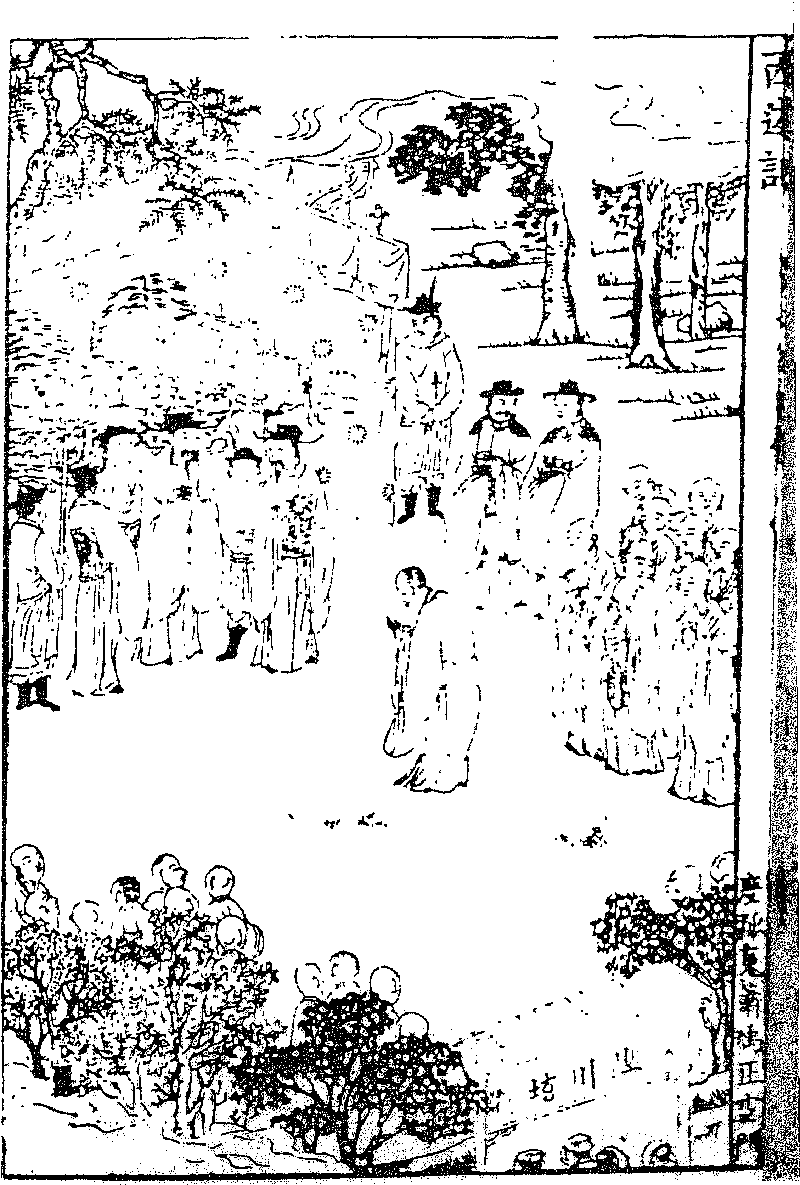
| 11 | 唐王秉誠... : |
次日三位朝臣,聚眾僧,在那山川壇裡,逐一從頭查選,內中選得一名有德行的高僧。你道他是誰人? 靈通本諱號金蟬,只為無心聽佛講。 轉托塵凡苦受磨,降生世俗遭羅網。 投胎落地就逢兇,未出之前臨惡黨。 父是海州陳狀元,外公總管當朝長。 出身命犯落江星,順水隨波逐浪泱。 海島金山有大緣,遷安和尚將他養。 年方十八認親娘,特赴京都求外長。 總管開山調大軍,洪州剿寇誅兇黨。 狀元光蕊脫天羅,子父相逢堪賀獎。 復謁當今受主恩,凌煙閣上賢名響。 恩官不受願為僧,洪福沙門將道訪。 小字江流古佛兒,法名喚做陳玄奘。 |
| The next day, the three ministers gathered the monks at the mountain and river altar, examining them one by one from beginning to end. Among them, they selected a virtuous and learned monk of high moral character. You may wonder who this person was? His original name was Lingtong, and his courtesy name was Jinchuan. He had merely neglected to listen attentively to the Buddha's teachings without intention. He was reborn into the mortal world, enduring hardships and suffering; he descended into worldly life, caught in the web of fate. From the moment he was born, he encountered misfortune; even before birth, he faced evil forces. His father was Chen Zhuangyuan of Haizhou, and his maternal grandfather served as the chief minister of the current dynasty. Born with a destiny marked by the "Luojiang Star," he was fated to drift along rivers and waves, tossed about by tides. By great fortune, there were profound karmic connections at the Golden Hill on the island of Hai Dao; it was the monk Qian'an who raised him. At eighteen, he finally recognized his birth mother and specially traveled to the capital to seek out his maternal uncle. The chief minister mobilized troops and led a large army, marching to Hongzhou to suppress bandits and eliminate the wicked faction. Zhuangyuan Guangrui escaped from the heavenly net, and father and son reunited—a joyous occasion worthy of celebration and reward. They then paid homage to the current emperor, receiving imperial favor; their virtuous names echoed in the Linyan Pavilion of honored officials. Though offered official posts, he refused them and wished to become a monk; it was Hongfu Shamen who sought the path for him. His childhood name was Jiangliu, the child of an ancient Buddha; his Dharma name was Chen Xuanzang. | ||
| 12 | 唐王秉誠... : | 當日對眾舉出玄奘法師。這個人自幼為僧,出娘胎,就持齋受戒。他外公見是當朝一路總管殷開山。他父親陳光蕊中狀元,官拜文淵殿大學士。一心不愛榮華,只喜修持寂滅。查得他根源又好,德行又高;千經萬典,無所不通;佛號仙音,無般不會。 |
| On that day, they publicly selected Master Xuanzang before the assembly. This man had been a monk since childhood; even from his mother's womb, he observed vegetarianism and received precepts. His maternal grandfather was Yin Kaishan, the chief administrator of the current dynasty along one route. His father, Chen Guangrui, had passed the imperial examination as Zhuangyuan and was appointed Grand Secretary of the Wenyuan Pavilion. He cared little for glory or wealth but loved to cultivate himself in quiet extinction (nirvana). They found that his lineage was excellent and his virtue lofty; he understood all the thousands of sutras and classics without exception; Buddhist teachings, divine sounds—there was none he did not master. | ||
| 13 | 唐王秉誠... : | 當時三位引至御前,揚塵舞蹈。拜罷奏曰:「臣瑀等蒙聖旨,選得高僧一名陳玄奘。」太宗聞其名,沉思良久道:「可是學士陳光蕊之兒玄奘否?」江流兒叩頭曰:「臣正是。」太宗喜道:「果然舉之不錯,誠為有德行有禪心的和尚。朕賜你左僧綱,右僧綱,天下大闡都僧綱之職。」玄奘頓首謝恩,受了大闡官爵。又賜五彩織金袈裟一件、毘盧帽一頂。教他用心再拜明僧,排次闍黎班首,書辦旨意,前赴化生寺,擇定吉日良時,開演經法。 |
| At that time, the three officials led him before the throne, where they performed ceremonial dances and paid homage with dust raised in reverence. After bowing, Xiao Yu reported: "Your subjects, Ruyi et al., have followed Your Majesty's decree and selected a virtuous monk named Chen Xuanzang." Emperor Taizong heard the name and pondered for a long time, then asked: "Is this not Xuanzang, the son of Grand Secretary Chen Guangrui?" Jiangliuer knelt and said, "I am indeed." Emperor Taizong rejoiced and said: "Indeed, the selection was correct. You are truly a monk of virtue and devotion to Chan practice." "I hereby bestow upon you the title Zuo Senggang, You Senggang, and the position of Dachan Dusenggang over all monks in the realm." Xuanzang knelt with clasped hands to thank for the grace and accepted the official title of Dachan. He was also granted a robe woven in five-colored brocade, as well as one Pilu hat. He was instructed to carefully pay homage once more to the enlightened monks, arrange his position among the senior monks in order, prepare and deliver imperial decrees, proceed to Huasheng Temple, select an auspicious day and hour, and begin expounding Buddhist scriptures. | ||
| 14 | 唐王秉誠... : | 玄奘再拜領旨而出,遂到化生寺裡,聚集多僧,打造禪榻,裝修功德,整理音樂。選得大小明僧共計一千二百名,分派上中下三堂。諸所佛前,物件皆齊,頭頭有次。選到本年九月初三日黃道良辰,開啟做七七四十九日水陸大會。即具表申奏。太宗及文武國戚皇親,俱至期赴會,拈香聽講。有詩為證。詩曰: |
| Xuanzang bowed twice to receive the decree and left, proceeding directly to Huasheng Temple. There he gathered many monks, prepared meditation platforms, renovated merit-making facilities, and arranged musical performances. He selected a total of 1,200 enlightened monks of all ranks and assigned them to the upper, middle, and lower halls. All items before the Buddha statues were complete, each arranged in proper order. They selected the auspicious hour of September 3rd of this year and began a grand water-and-land assembly lasting forty-nine days, seven weeks in total. He immediately prepared a memorial to submit for imperial approval. Emperor Taizong, as well as the civil and military officials, royal relatives, and imperial family members, all attended on schedule to burn incense and listen to the lectures. There is a poem to attest to this: The poem reads: | ||
|
龍集貞觀正十三,王宣大眾把經談。 道場開演無量法,雲霧光乘大願龕。 御敕垂恩修上剎,金蟬脫殼化西涵。 普施善果超沉沒,秉教宣揚前後三。 | ||
| In the year of the Dragon, the thirteenth year of Zhen Guan reign, the king summoned the people to discuss the sutras. The Dharma assembly expounded boundless teachings; clouds and mists illuminated the great vow hall. Imperial grace bestowed to build a grand temple, like the golden cicada shedding its shell and transforming toward the West. Widely spreading good fruits to deliver those in suffering, upholding the teachings and promoting them before and after three times. | ||
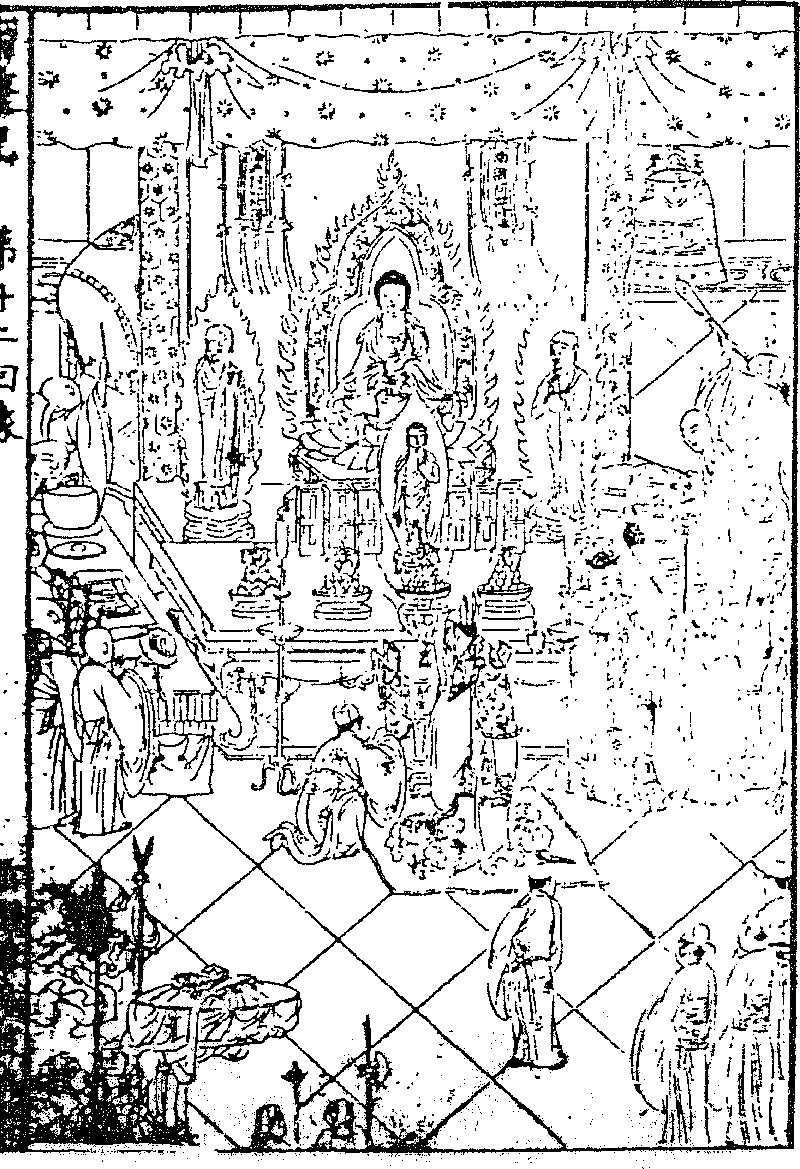
| 15 | 唐王秉誠... : | 貞觀十三年,歲次己巳,九月甲戌,初三日,癸卯良辰,陳玄奘大闡法師聚集一千二百名高僧,都在長安城化生寺開演諸品妙經。那皇帝早朝已畢,帥文武多官,乘鳳輦龍車,出離金鑾寶殿,徑上寺來拈香。怎見那鑾駕?真個是: |
| In the thirteenth year of the Zhenguan era, the Year of Ji Si (365 AD), on the Jia Xu day of the ninth month, the third day, which was a Gui Mao auspicious hour, Master Chen Xuanzang gathered 1,200 virtuous monks at Huasheng Temple in Chang'an City to expound various profound Buddhist scriptures. The emperor, having finished his morning court session, led the civil and military officials in phoenix-drawn palanquins and dragon chariots. He left the Jinluan Bao Dian (Golden Dragon Treasure Hall) directly for the temple to burn incense. What did this imperial procession look like? Indeed, it was: | ||
| 一天瑞氣,萬道祥光。仁風輕淡蕩,化日麗非常。千官環佩分前後,五衛旌旗列兩旁。執金瓜,擎斧鉞,雙雙對對;絳紗燭,御爐香,靄靄堂堂。龍飛鳳舞,鶚薦鷹揚。聖明天子正,忠義大臣良。介福千年過舜禹,昇平萬代賽堯湯。又見那曲柄傘,滾龍袍,輝光相射;玉連環,彩鳳扇,瑞靄飄揚。珠冠玉帶,紫綬金章。護駕軍千隊,扶輿將兩行。這皇帝沐浴虔誠尊敬佛,皈依善果喜拈香。 | ||
| A day filled with auspicious energy, ten thousand beams of radiant light. The benevolent breeze was gentle and refreshing; the enlightened days were exceptionally bright. Thousand officials, adorned with jade pendants, formed ranks before and behind; five divisions of guards displayed their banners on both sides. Holding golden gourds, wielding axes and halberds, they stood in pairs facing each other; Scarlet silk candles and imperial incense burners filled the air with a dignified and solemn atmosphere. Dragons soared, phoenixes danced; eagles displayed their might while hawks circled above. A sage and just emperor ruled righteously, with loyal and virtuous ministers at his side. The blessings of a thousand years surpassed those of Shun and Yu; the peace of ten thousand generations outshone that of Yao and Tang. They also saw the curved parasol, the dragon-embroidered robe, their brilliance shining together; jade-linked rings and colorful phoenix fans floated with auspicious mists. Pearl-capped hats, jade sashes; purple silk cords and golden seals. Thousand squads of imperial guards protected the procession, while two rows of attendants supported the palanquin. This emperor, with pure sincerity and reverence for the Buddha, had taken refuge in good fruits and joyfully burned incense. | ||
| 16 | 唐王秉誠... : | 唐王大駕早到寺前,吩咐住了音樂響器。下了車輦,引著多官,拜佛拈香。三匝已畢,擡頭觀看,果然好座道場。但見: |
| Emperor Taizong arrived at the temple early with his grand procession and ordered the music and instruments to be stopped. He stepped down from his palanquin, led by many officials, and paid homage to the Buddha with incense in hand. After completing three circumambulations, he looked up and observed—indeed a magnificent place of worship. One could see: | ||
| 幢幡飄舞,寶蓋飛輝。幢幡飄舞,凝空道道彩霞搖;寶蓋飛輝,映日翩翩紅電徹。世尊金像貌臻臻,羅漢玉容威烈烈。瓶插仙花,爐焚檀降。瓶插仙花,錦樹輝輝漫寶剎;爐焚檀降,香雲靄靄透清霄。時新果品砌朱盤,奇樣糖酥堆彩案。高僧羅列誦真經,願拔孤魂離苦難。 | ||
| Ornamental banners fluttered and danced, while jewel-like canopies radiated brilliant light. The banners fluttered in the air, with colorful clouds shimmering across the sky; the jewel-like canopies glowed brilliantly, their red radiance piercing through the sunlight like dancing lightning. The golden image of the Buddha was dignified and serene; the jade-like visages of the Arhats exuded solemn majesty. Vases held sacred flowers, while incense burners released fragrant sandalwood smoke. Vases holding divine flowers displayed radiant trees adorning the sacred temple; incense burners emitting fragrant sandalwood released a misty aroma that drifted into the clear sky. Seasonal fruits were arranged on red lacquered trays, while delicacies and candied pastries piled up in colorful arrangements on ornate tables. Senior monks lined up to recite the true scriptures, praying for the liberation of lonely souls from suffering. | ||
| 17 | 唐王秉誠... : | 太宗文武俱各拈香,拜了佛祖金身,參了羅漢。又見那大闡都綱陳玄奘法師引眾僧羅拜唐王。禮畢,分班各安禪位。法師獻上濟孤榜文與太宗看。榜曰: |
| Emperor Taizong, both a scholar and warrior, burned incense and paid homage to the golden statue of the Buddha, then paid respects to the Arhats. He also saw the Grand Preceptor Chen Xuanzang leading a group of monks in prostration before Emperor Taizong. After the ceremony, they divided into groups and took their respective meditation seats. The master presented a scroll to Emperor Taizong for him to read, which detailed how to rescue the lonely souls. The scroll stated: | ||
| 至德渺茫,禪宗寂滅。清淨靈通,周流三界。千變萬化,統攝陰陽。體用真常,無窮極矣。觀彼孤魂,深宜哀愍。此奉太宗聖命:選集諸僧,參禪講法。大開方便門庭,廣運慈悲舟楫,普濟苦海群生,脫免沉痾六趣。引歸真路,普玩鴻濛;動止無為,混成純素。仗此良因,邀賞清都絳闕;乘吾勝會,脫離地獄凡籠。早登極樂任逍遙,來往西方隨自在。 | ||
| Highest virtue is boundless; Chan Buddhism leads to extinction of suffering. Purity and spiritual insight flow throughout the three realms. With countless transformations, they govern both yin and yang. The essence and function are truly eternal, without end or limit. Behold those lonely souls; they deeply deserve compassion. This is in accordance with Emperor Taizong's sacred decree: to gather monks, meditate on Chan, and expound the Dharma. Open wide the gate of convenience, broadly operate the boat of compassion; universally rescue all beings from the suffering sea and free them from the six paths of rebirth. Guide them back to the true path, allowing all to partake in the primordial unity; Act without action, and return to pure simplicity. Relying on this good cause, they may seek reward in the celestial palaces of Qingdu and Jiangque; Seizing this auspicious gathering, they shall escape from the ordinary confines of hell. Soon ascend to the Land of Ultimate Bliss and wander in freedom; come and go at will in the Western Paradise. | ||
| 18 | 唐王秉誠... : | 詩曰: |
| A verse says: | ||
|
一爐永壽香,幾卷超生籙。 無邊妙法宣,無際天恩沐。 冤孽盡消除,孤魂皆出獄。 願保我邦家,清平萬咸福。 | ||
| One censer of eternal longevity incense, a few scrolls of records for transcending rebirth. The boundless wondrous Dharma is proclaimed; the endless grace of heaven is received. All grievances and karmic debts are completely eliminated, and lonely souls all escape from hell. May our nation and family be protected; may peace and universal blessings endure for ten thousand years. | ||
| 19 | 唐王秉誠... : | 太宗看了,滿心歡喜,對眾僧道:「汝等秉立丹衷,切休怠慢佛事。待後功成完備,各各福有所歸,朕當重賞,決不空勞。」那一千二百僧,一齊頓首稱謝。當日三齋已畢,唐王駕回。待七日正會,復請拈香。時天色將晚,各官俱退。怎見得好晚?你看那: |
| Emperor Taizong read it with great joy and said to the monks, "All of you must uphold your sincere devotion; do not neglect Buddhist practices. Once your efforts are complete and perfected, each of you shall receive the blessings due to you; I will reward you greatly, and no one's labor shall be in vain." The 1200 monks all bowed their heads together in gratitude. After the three meals of the day were completed, Emperor Taizong returned to his palace. They would wait for the main ceremony on the seventh day and then invite him again to burn incense. As evening approached, all officials withdrew. How beautiful was the evening? Look at how: | ||
|
萬里長空淡落暉,歸鴉數點下棲遲。 滿城燈火人煙靜,正是禪僧入定時。 | ||
| The vast sky stretched for miles, faintly glowing with the setting sun; a few crows returned home in slow flight. The city was quiet under its lanterns and smoke, precisely the time when Chan monks entered deep meditation. | ||
| 20 | 唐王秉誠... : | 一宿晚景題過。次早,法師又昇坐,聚眾誦經不題。 |
| Thus ended one night's description of the evening scenery. The next morning, the master ascended his seat again and gathered the monks to recite scriptures—no further details are given. | ||
| 21 | 唐王秉誠... : | 卻說南海普陀山觀世音菩薩,自領了如來佛旨,在長安城訪察取經的善人,日久未逢真實有德行者。忽聞得太宗宣揚善果,選舉高僧,開建大會。又見得法師壇主,乃是江流兒和尚,正是極樂中降來的佛子,又是他原引送投胎的長老。菩薩十分歡喜,就將佛賜的寶貝捧上長街,與木叉貨賣。你道他是何寶貝?有一件錦襴異寶袈裟、九環錫杖。還有那金緊禁三個箍兒,密密藏收,以俟後用。只將袈裟、錫杖出賣。 |
| Meanwhile, Guanyin Bodhisattva of Mount Potala in the Southern Sea, having received the Buddha's decree to search for a virtuous person in Chang'an who would seek the scriptures, had long been unable to find anyone truly worthy and moral. Suddenly, he heard that Emperor Taizong was promoting good deeds, selecting eminent monks, and holding a grand assembly. He also learned that the master presiding over the platform was Master Jiangliuer, a son of the Buddha who had descended from the Land of Ultimate Bliss. He was also the elder monk who had originally guided and sent him to be reborn. The Bodhisattva was extremely pleased, so he took the treasures bestowed by the Buddha and brought them to a main street, where he asked Mu Cha to sell them. You may wonder what these treasures were? There was a rare and precious brocade robe, as well as a nine-ring alms staff. He also had the three golden, tight, and forbidden rings, which were carefully hidden away for future use. Only the robe and staff were put up for sale. | ||
| 22 | 唐王秉誠... : | 長安城裡,有那選不中的愚僧,倒有幾貫村鈔。見菩薩變化個疥癩形容,身穿破衲,赤腳光頭,將袈裟捧定,豔豔生光,他上前問道:「那癩和尚,你的袈裟要賣多少價錢?」菩薩道:「袈裟價值五千兩,錫杖價值二千兩。」那愚僧笑道:「這兩個癩和尚是瘋子!是傻子!這兩件粗物,就賣得七千兩銀子?只是除非穿上身長生不老,就得成佛作祖,也值不得這許多!拿了去!賣不成!」 |
| In Chang'an, there were some foolish monks who had failed to be selected but still possessed a few strings of rural copper coins. Seeing the Bodhisattva transformed into a leprous and scrofulous figure, wearing tattered robes, barefoot and bald-headed, holding up the robe which radiated brilliant light, one of them stepped forward and asked, "Leprous monk, how much do you want for your robe?" The Bodhisattva said, "This robe is worth 5000 taels of silver, and the staff is worth 2000 taels." The foolish monk laughed and said, "These two leprous monks are madmen! They're fools!" How could these two simple pieces of cloth be worth 7000 taels of silver? Unless wearing them grants eternal life and makes one a Buddha or patriarch, they are not worth that much! Take it away!" It can't be sold!" | ||
| 23 | 唐王秉誠... : | 那菩薩更不爭吵,與木叉往前又走。行勾多時,來到東華門前,正撞著宰相蕭瑀散朝而回,眾頭踏喝開街道。那菩薩公然不避,當街上拿著袈裟,徑迎著宰相。宰相勒馬觀看,見袈裟豔豔生光,著手下人問那賣袈裟的要價幾何,菩薩道:「袈裟要五千兩,錫杖要二千兩。」蕭瑀道:「有何好處,值這般高價?」菩薩道:「袈裟有好處,有不好處;有要錢處,有不要錢處。」蕭瑀道:「何為好?何為不好?」菩薩道:「著了我袈裟,不入沉淪,不墮地獄,不遭惡毒之難,不遇虎狼之災,便是好處;若貪淫樂禍的愚僧,不齋不戒的和尚,毀經謗佛的凡夫,難見我袈裟之面,這便是不好處。」又問道:「何為要錢,不要錢?」菩薩道:「不遵佛法,不敬三寶,強買袈裟、錫杖,定要賣他七千兩,這便是要錢;若敬重三寶,見善隨喜,皈依我佛,承受得起,我將袈裟、錫杖情願送他,與我結個善緣,這便是不要錢。」蕭瑀聞言,倍添春色,知他是個好人。即便下馬,與菩薩以禮相見,口稱:「大法長老,恕我蕭瑀之罪。我大唐皇帝十分好善,滿朝的文武無不奉行。即今起建水陸大會,這袈裟正好與大都闡陳玄奘法師穿用。我和你入朝見駕去來。」 |
| The Bodhisattva did not argue further, but instead walked on with Mu Cha. After walking for a long time, they arrived at the front of Donghua Gate and just happened to meet Chancellor Xiao Yu returning from court. The crowd cleared the street as he passed by. The Bodhisattva boldly stepped forward without avoiding, holding up the robe and directly approaching the chancellor. Chancellor Xiao Yu reined in his horse and looked on. Seeing the robe radiating brilliant light, he asked his attendants to inquire of the monk selling it how much it cost. The Bodhisattva replied, "The robe is worth 500 taels, and the staff 200." Xiao Yu asked, "What special virtues does it have to be priced so highly?" The Bodhisattva replied: "This robe has both advantages and disadvantages; there are places where it brings money, and places where it does not." Xiao Yu asked: "What is the advantage?" "What is the disadvantage?" The Bodhisattva said: "Wearing my robe, one will not fall into the cycle of suffering, nor descend to hell, nor suffer from poison or calamities, nor encounter disasters from tigers and wolves—this is its advantage; if a foolish monk is greedy, lustful, and fond of calamity; if a monk does not observe the precepts or fasts; or if an ordinary person defames the Buddha and destroys the scriptures—such people cannot even see my robe. This is its disadvantage." Xiao Yu then asked, "What do you mean by 'brings money' and 'does not bring money'?" The Bodhisattva explained: "If someone disrespects the Buddha's teachings, does not honor the Three Treasures, and forcefully buys my robe or staff, I will definitely sell it for 7000 taels—this is 'brings money'; if someone reveres the Three Treasures, rejoices in virtue when seen, takes refuge in my Buddha, and is worthy of receiving it, I will willingly give him the robe and staff to form a good karmic connection with me—this is 'does not bring money.'" Upon hearing these words, Xiao Yu's face lit up with renewed admiration and he realized that this was a truly virtuous man. He immediately dismounted his horse, greeted the Bodhisattva with courtesy, and said respectfully: "Reverend Master Dafa, please forgive my sins, Chancellor Xiao Yu. Our great Tang emperor is deeply devoted to virtue, and all the civil and military officials in court follow this example without exception. Now that we are holding a grand water and land assembly, this robe is just right for the Grand Preceptor Chen Xuan Zang to wear. I will go with you to present yourself before the emperor." | ||
| 24 | 唐王秉誠... : | 菩薩欣然從之,拽轉步,徑進東華門裡。黃門官轉奏,蒙旨宣至寶殿。見蕭瑀引著兩個疥癩僧人,立於階下,唐王問曰:「蕭瑀來奏何事?」蕭瑀俯伏階前道:「臣出了東華門前,偶遇二僧,乃賣袈裟與錫杖者。臣思法師玄奘可著此服,故領僧人啟見。」太宗大喜,便問那袈裟價值幾何。菩薩與木叉侍立階下,更不行禮,因問袈裟之價,答道:「袈裟五千兩,錫杖二千兩。」太宗道:「那袈裟有何好處,就值許多?」菩薩道: |
| The Bodhisattva happily agreed, turned his steps, and directly entered through Donghua Gate. The palace attendants reported this to the emperor, who then summoned them to the Treasure Hall. Seeing Xiao Yu leading two leprous-looking monks standing at the steps, Emperor Taizong asked, "Xiao Yu, what matter do you report?" Xiao Yu knelt before the steps and said, "Your servant was outside Donghua Gate when I happened to meet two monks who were selling a robe and staff. I thought that Master Xuanzang might be worthy of wearing them, so I brought the monks here for an audience." Emperor Taizong was greatly pleased and asked about the robe's value. The Bodhisattva and Mu Cha stood at the steps without bowing. When asked about the price of the robe, they replied, "The robe is worth 5,000 taels; the staff, 2,000." Emperor Taizong said, "What good does that robe have to be worth so much?" The Bodhisattva said: | ||
| 這袈裟,龍披一縷,免大鵬吞噬之災;鶴掛一絲,得超凡入聖之妙。但坐處,有萬神朝禮;凡舉動,有七佛隨身。這袈裟,是冰蠶造練抽絲,巧匠翻騰為線,仙娥織就,神女機成,方方簇幅繡花縫。片片相幫堆錦簆。玲瓏散碎鬥妝花,色亮飄光噴寶豔。穿上滿身紅霧遶,脫來一段彩雲飛。三天門外透元光,五岳山前生寶氣。重重嵌就西番蓮,灼灼懸珠星斗象。四角上有夜明珠,攢頂間一顆祖母綠。雖無全照原本體,也有生光八寶攢。這袈裟,閑時折疊,遇聖才穿。閑時折疊,千層包裹透虹霓;遇聖才穿,驚動諸天神鬼怕。上邊有如意珠、摩尼珠、辟塵珠、定風珠;又有那紅瑪瑙、紫珊瑚、夜明珠、舍利子。偷月沁白,與日爭紅。條條仙氣盈空,朵朵祥光捧聖。條條仙氣盈空,照徹了天關;朵朵祥光捧聖,影遍了世界。照山川,驚虎豹;影海島,動魚龍。沿邊兩道銷金鎖,叩領連環白玉琮。 | ||
| This robe, when worn by a dragon, protects it from being devoured by the great phoenix; if a crane merely fastens one thread of it, it attains the wondrous ability to transcend the mundane and enter sainthood. Whenever worn by someone sitting in meditation, ten thousand deities will pay homage; in every action taken, seven Buddhas accompany the wearer. This robe was made from the silk of ice silkworms, twisted into thread by skilled artisans, woven by immortal maidens on a loom operated by divine women, and each panel is embroidered with clustered floral patterns. Each piece is carefully matched to form an elaborate brocade pattern. The robe features delicate, scattered floral patterns in dazzling colors that shimmer with radiant light and precious brilliance. When worn, it is as if red mist surrounds the body; when removed, a streak of colorful clouds flies away. Its radiance pierces through the Three Heavens' gates, and its aura brings forth treasures before the Five Sacred Mountains. Each layer is inlaid with western lotus patterns, and brilliant pearl-like gems hang like constellations. At each of its four corners are night pearls, and at the center top is a single emerald. Though it does not fully reflect the original form, it still gathers the radiance of eight treasures. This robe is folded and stored when idle; only a sage may wear it. When folded for storage, its many layers encase a rainbow's glow; When worn by a sage, it startles the gods and spirits of all heavens. It is adorned with a wish-fulfilling pearl, a Mani pearl, a dust-repelling pearl, and a wind-stilling pearl; it also has red jasper, purple coral, night pearls, and relics. It steals the moon's pale light and competes with the sun in its crimson glow. Each thread exudes divine energy that fills the air, while clusters of auspicious radiance surround the sage. Thread by thread, its divine aura fills the sky and illuminates the celestial gates; cluster by cluster of auspicious light supports the sage, casting shadows across the world. It illuminates mountains and rivers, startling tigers and leopards; its reflection on sea isles stirs fish and dragons. Along the edges are two golden tassels, while a white jade chime connects to the collar in a linked ring. | ||
| 25 | 唐王秉誠... : | 詩曰: |
| A verse says: | ||
|
三寶巍巍道可尊,四生六道盡評論。 明心解養人天法,見性能傳智慧燈。 護體莊嚴金世界,身心清淨玉壺冰。 自從佛製袈裟後,萬劫誰能敢斷僧?」 | ||
| The Three Jewels stand lofty and their Way is revered; all beings in the Four Lives and Six Paths are subject to evaluation. Clarifying one's mind reveals the teachings that nurture both humans and gods, for seeing into one's nature transmits the lamp of wisdom. Protecting the body with dignified golden radiance, purifying mind and body like ice in a jade vase. Since the Buddha first made this robe, who dares to harm a monk through ten thousand kalpas?" | ||
| 26 | 唐王秉誠... : | 唐王在那寶殿上聞言,十分歡喜。又問:「那和尚,九環杖有甚好處?」菩薩道:「我這錫杖,是那: |
| Emperor Taizong, upon hearing these words in the Treasure Hall, was extremely pleased. He then asked, "Monks, what good does this Nine-Ring Staff have?" The Bodhisattva replied, "My staff is one that: | ||
|
銅鑲鐵造九連環,九節仙藤永駐顏。 入手厭看青骨瘦,下山輕帶白雲還。 摩啊五祖遊天闕,羅卜尋娘破地關。 不染紅塵些子穢,喜伴神僧上玉山。」 | ||
| is forged with iron and inlaid with copper, forming nine interlocking rings; its nine sections of immortal vine preserve youth forever. When held, it makes one weary of gazing at the withered green bones; when descending a mountain, it lightly carries white clouds back. It was once wielded by Wuzu as he roamed the heavenly gates; it helped Luobo find his mother and break through earthly barriers. It remains unstained by even a trace of worldly filth, rejoicing in the company of sages ascending Jade Mountain." | ||
| 27 | 唐王秉誠... : | 唐王聞言,即命展開袈裟,從頭細看,果然是件好物。道:「大法長老,實不瞞你。朕今大開善教,廣種福田,見在那化生寺聚集多僧,敷演經法。內中有一個大有德行者,法名玄奘。朕買你這兩件寶物,賜他受用。你端的要價幾何?」菩薩聞言,與木叉合掌皈依,道聲佛號,躬身上啟道:「既有德行,貧僧情願送他,決不要錢。」說罷,抽身便走。唐王急著蕭瑀扯住,欠身立於殿上,問曰:「你原說袈裟五千兩,錫杖二千兩,你見朕要買,就不要錢,敢是說朕心倚恃君位,強要你的物件?更無此理。朕照你原價奉償,卻不可推避。」菩薩起手道:「貧僧有願在前,原說果有敬重三寶,見善隨喜,皈依我佛,不要錢,願送與他。今見陛下明德止善,敬我佛門;況又高僧有德有行,宣揚大法,理當奉上,決不要錢。貧僧願留下此物告回。」唐王見他這等懃懇,甚喜。隨命光祿寺,大排素宴酬謝。菩薩又堅辭不受,暢然而去,依舊望都土地廟中隱避不題。 |
| Upon hearing this, Emperor Taizong immediately ordered the robe to be unfolded and examined in detail. Indeed, it was a truly fine object. He said, "Venerable Master Dafa, I will not hide this from you. Today, I am greatly promoting the teachings of goodness and cultivating fields of merit; many monks have gathered at Huasheng Temple to expound the sutras. Among them is a particularly virtuous monk, whose dharma name is Xuanzang. I will buy these two treasures from you and bestow them upon him for his use. What is your actual price?" Upon hearing this, the Bodhisattva clasped hands with Mu Cha in reverence, chanted a Buddha's name, and respectfully addressed the emperor: "Since he is so virtuous, I, a poor monk, am willing to give these items to him freely; I certainly do not want any money." After saying this, the Bodhisattva turned and walked away. Emperor Taizong hurriedly ordered Xiao Yu to stop him, then stood respectfully in the hall and asked, "You originally said the robe was worth 5000 taels and the staff 2000. Now that I want to buy them, you refuse payment—could it be that you think I rely on my imperial position to take your belongings by force? That is even more unreasonable. I will pay you the original price, and you cannot refuse." The Bodhisattva raised his hand and said, "I made a vow beforehand. I originally vowed that if there was someone who truly respects the Three Jewels, practices kindness joyfully, and takes refuge in Buddhism, then without money, I would be willing to give it to him. Now that I see Your Majesty's bright virtue halting evil and respecting our Buddhist tradition; and since there is also a virtuous and exemplary great monk who proclaims the Dharma, it is only right to present these items freely without accepting money. I, this poor monk, am willing to leave behind these things as a gift and now take my leave." Emperor Taizong saw how earnest he was and was very pleased. He immediately ordered the Guanglu Temple to prepare a grand vegetarian banquet as a token of gratitude. The Bodhisattva once again firmly declined the banquet and left calmly, returning to his usual hiding place at the local land god temple in the capital. | ||
| 28 | 唐王秉誠... : | 卻說太宗設午朝,著魏徵賫旨,宣玄奘入朝。那法師正聚眾登壇,諷經誦偈,一聞有旨,隨下壇整衣,與魏徵同往見駕。太宗道:「求證善事,有勞法師,無物酬謝。早間蕭瑀迎著二僧,願送錦襴異寶袈裟一件,九環錫杖一條。今特召法師領去受用。」玄奘叩頭謝恩。太宗道:「法師如不棄,可穿上與朕看看。」長老遂將袈裟抖開,披在身上,手持錫杖,侍立階前。君臣個個忻然。誠為如來佛子。你看他: |
| Meanwhile, Emperor Taizong convened a midday court session and ordered Wei Zheng to deliver an imperial decree summoning Xuanzang to the palace. At that moment, Master Xuanzang was gathering the assembly on a platform to recite sutras and verses. Upon hearing of the imperial decree, he immediately descended from the platform, tidied his robes, and went with Wei Zheng to present himself before the emperor. Emperor Taizong said: "For undertaking this meritorious task, I have troubled you, Master, and yet I can offer no gift in return. Earlier today, Xiao Yu encountered two monks who offered a robe of rare brocade and an unusual treasure, as well as a Nine-Ring staff. I have specially summoned you to receive these items for your use." Xuanzang kowtowed in gratitude. Emperor Taizong said: "Master, if you do not mind, please put it on so I may see." The elder monk then unfolded the robe and put it on, holding the staff in hand as he stood respectfully at the steps. All the emperor and his ministers were delighted. He was indeed a true son of the Buddha. Look at him: | ||
|
凜凜威顏多雅秀,佛衣可體如裁就。 暉光豔豔滿乾坤,結綵紛紛凝宇宙。 朗朗明珠上下排,層層金線穿前後。 兜羅四面錦沿邊,萬樣稀奇鋪綺繡。 八寶妝花縛鈕絲,金環束領攀絨扣。 佛天大小列高低,星象尊卑分左右。 玄奘法師大有緣,現前此物堪承受。 渾如極樂活阿羅,賽過西方真覺秀。 錫杖叮噹鬥九環,毘盧帽映多豐厚。 誠為佛子不虛傳,勝似菩提無詐謬。 | ||
| His dignified and noble countenance is both elegant and refined; the Buddha's robe fits his body as if tailor-made. Its radiant glow fills heaven and earth, while colorful patterns gather and condense throughout the universe. Clear pearls shine in rows above and below; golden threads weave through layers front and back. The robe's four sides are bordered with brocade, adorned with countless rare and exquisite embroidered patterns. Eight treasures form floral fastenings on the silk buttons; golden rings secure the collar with soft, pliable clasps. The robe displays Buddhist and celestial symbols in varying sizes and ranks, while constellations mark positions of honor on either side. Master Xuanzang is truly fortunate; such an object as this is worthy to be received by him. He appears like a living Arhat of the Pure Land, surpassing even the true enlightenment of the Western Paradise in grace and beauty. The Nine-Ring staff rings softly as it is raised, while the Vairocana hat above reflects great dignity and richness. Truly a son of the Buddha, his reputation is not in vain; he surpasses even Bodhi itself without deceit or falsehood. | ||
| 29 | 唐王秉誠... : | 當時文武階前喝采。太宗喜之不勝,即著法師穿了袈裟,持了寶杖;又賜兩隊儀從,著多官送出朝門,教他上大街行道,往寺裡去,就如中狀元誇官的一般。這去玄奘再拜謝恩,在那大街上,烈烈轟轟,搖搖擺擺。你看那長安城裡,行商坐賈、公子王孫、墨客文人、大男小女,無不爭看誇獎,俱道:「好個法師,真是個活羅漢下降,活菩薩臨凡。」 |
| At that moment, both civil and military officials at the steps applauded enthusiastically. Emperor Taizong could not contain his joy; he immediately had Master Xuanzang put on the robe and take up the staff. He also bestowed two processions of attendants and ordered many officials to escort him out through the palace gates, instructing him to walk down the main street toward the temple in a manner similar to that of a newly crowned imperial scholar being paraded in public. Thus, Xuanzang bowed twice in gratitude and proceeded down the street with great fanfare, his procession moving proudly and majestically. Look at the city of Chang'an—merchants on the move and shopkeepers seated, young noblemen and scholars, literati and common people, both men and women—young and old—all rushed to look and praise him, saying: "What a great master! Truly an incarnate Arhat or Bodhisattva descending from heaven!" | ||
| 30 | 唐王秉誠... : | 玄奘直至寺裡,僧人下榻來迎。一見他披此袈裟,執此錫杖,都道是地藏王來了,各各歸依,侍於左右。玄奘上殿,炷香禮佛。又對眾感述聖恩已畢,各歸禪座。又不覺紅輪西墜。正是那: |
| Xuanzang finally arrived at the temple, where monks came out to greet him with great ceremony. Upon seeing him clad in this robe and holding the staff, they all said that it was Lord Dizang himself who had arrived. One by one, they took refuge with him and stood at his side. Xuanzang ascended the hall, lit incense, and paid homage to the Buddha. After addressing the assembly and expressing gratitude for the emperor's kindness, he returned everyone to their meditation seats. Before long, the red sun had sunk in the west. It was just as said: | ||
|
日落煙迷草樹,帝都鐘鼓初鳴。叮叮三響斷人行。前後街前寂靜。 上剎輝煌燈火,孤村冷落無聲。禪僧入定理殘經。正好煉魔養性。 | ||
| The sun set, and mist obscured the grass and trees; in the imperial capital, the bells and drums of the city began to sound. With three clear chimes, all pedestrian traffic was halted. The streets in front and behind fell into silence. The upper pagoda shone with brilliant lights, while the lonely village lay desolate and silent. Zen monks entered samadhi to study their remaining scriptures. This was just the right time for refining one's spirit and cultivating virtue. | ||
| 31 | 唐王秉誠... : | 光陰撚指,卻當七日正會。玄奘又具表,請唐王拈香。此時善聲遍滿天下。太宗即排駕,率文武多官、后妃國戚,早赴寺裡。那一城人,無論大小尊卑,俱詣寺聽講。 |
| Time passed swiftly, and it had come to be exactly seven days later, a significant gathering day. Xuanzang once again prepared a memorial, requesting Emperor Tang to burn incense in offering. At this time, the sound of virtue and goodness spread throughout the world. Emperor Taizong immediately prepared his imperial procession and led a large number of civil and military officials, as well as empresses, concubines, and royal relatives, to the temple early. All the people in the city, regardless of age or status, went to the temple to listen to the lecture. | ||
| 32 | 唐王秉誠... : | 當有菩薩與木叉道:「今日是水陸正會,以一七繼七七,可矣了。我和你雜在眾人叢中,一則看他那會何如,二則看金蟬子可有福穿我的寶貝,三則也聽他講的是那一門經法。」兩人隨投寺裡。正是有緣得遇舊相識,般若還歸本道場。入到寺裡觀看,真個是: |
| At that time, Bodhisattva said to Mu Chao: "Today is the main gathering for the water and land dharma assembly. One week following seven weeks will suffice." "I and you should blend into the crowd. First, we shall see how that gathering goes; second, we'll observe whether Jin Chanzi has the fortune to wear my treasure; third, I also want to hear which scripture or dharma he will expound." The two of them then entered the temple. Indeed, it was by fate that they met an old acquaintance; Prajna returned to its original dharma hall. Upon entering the temple and taking a look, it truly was: | ||
| 天朝大國,果勝裟婆。賽過祇園舍衛,也不亞上剎招提。那一派仙音響喨,佛號喧嘩。 | ||
| A great empire under heaven—truly surpassing Jambudvipa. It surpassed the gardens of Jetavana and was no less than the grandest monasteries above. The divine music resounded, and Buddhist chants echoed loudly. | ||
| 33 | 唐王秉誠... : | 這菩薩直至多寶臺邊,果然是明智金蟬之相。詩曰: |
| This Bodhisattva approached the Dabao Platform, and indeed, he bore the appearance of Mingzhi Jinchan. The verse says: | ||
|
萬象澄明絕點埃,大典玄奘坐高臺。 超生孤魂暗中到,聽法高流市上來。 施物應機心路遠,出生隨意藏門開。 對看講出無量法,老幼人人放喜懷。 | ||
| All phenomena are clear and free from the slightest dust; Master Xuanzang, presiding over this grand ceremony, sits on a high platform. Lost souls are liberated in secret and arrive from the shadows; enlightened beings who listen to Dharma come down from lofty realms into the marketplace. Offering things according to karmic conditions, one's mind travels far; being born at will, the gate of wisdom opens wide. Facing the crowd and expounding countless Dharma teachings, both young and old felt joy in their hearts. | ||
| 34 | 唐王秉誠... : | 又詩曰: |
| Another verse says: | ||
|
因遊法界講堂中,逢見相知不俗同。 盡說目前千萬事,又談塵劫許多功。 法雲容曳舒群岳,教網張羅滿太空。 檢點人生歸善念,紛紛天雨落花紅。 | ||
| While touring the Dharma assembly hall, I encountered a familiar face who was no ordinary person. We spoke of countless matters before our eyes and discussed many merits from past kalpas. The Dharma clouds spread gently over the mountains, while the net of teachings stretched across the entire sky. Reflecting on life and returning to good thoughts, red petals fell like rain from the heavens. | ||
| 35 | 唐王秉誠... : | 那法師在臺上念一會《受生度亡經》,談一會《安邦天寶篆》,又宣一會《勸修功卷》。這菩薩近前來,拍著寶臺,厲聲高叫道:「那和尚,你只會談小乘教法,可會談大乘麼?」玄奘聞言,心中大喜,翻身跳下臺來,對菩薩起手道:「老師父,弟子失瞻多罪。見前的蓋眾僧人,都講的是小乘教法,卻不知大乘教法如何。」菩薩道:「你這小乘教法,度不得亡者超昇,只可渾俗和光而已。我有大乘佛法三藏,能超亡者昇天,能度難人脫苦,能修無量壽身,能作無來無去。」 |
| The master recited a while of the "Susheng Duwang Jing" (Scripture for Receiving Life and Delivering the Departed), discussed a while from the "Anbang Tianbao Zhuan," and then proclaimed a while from the "Quanxiu Gong Juan" (Treatise on Encouraging Meritorious Cultivation). The Bodhisattva stepped forward, struck the treasure platform, and shouted sternly: "Monk! You only know how to speak of Hinayana teachings—do you also know Mahayana?" Xuanzang, upon hearing this, was greatly delighted. He turned around and jumped down from the platform, raising his hands toward the Bodhisattva and saying: "Revered elder master, your disciple has been remiss in his reverence and is deeply at fault." All the monks before me have only expounded Hinayana teachings, but I do not know how to explain Mahayana." The Bodhisattva said: "Your Hinayana teachings cannot deliver the departed to transcend and ascend; they can only help one blend with the world and harmonize with its light." "I possess the Tripitaka of Mahayana Dharma, which can deliver the departed to ascend to heaven, rescue those in suffering from their difficulties, cultivate an imperishable body of infinite life, and attain a state beyond birth and death." | ||
| 36 | 唐王秉誠... : | 正講處,有那司香巡堂官急奏唐王道:「法師正講談妙法,被兩個疥癩遊僧扯下來亂說胡話。」王令擒來。只見許多人將二僧推擁進後法堂,見了太宗,那僧人手也不起,拜也不拜,仰面道:「陛下問我何事?」唐王卻認得他,道:「你是前日送袈裟的和尚?」菩薩道:「正是。」太宗道:「你既來此處聽講,只該吃些齋便了,為何與我法師亂講,擾亂經堂,誤我佛事?」菩薩道:「你那法師講的是小乘教法,度不得亡者昇天。我有大乘佛法三藏,可以度亡脫苦,壽身無壞。」太宗正色喜問道:「你那大乘佛法在於何處?」菩薩道:「在大西天天竺國大雷音寺我佛如來處,能解百冤之結,能消無妄之災。」太宗道:「你可記得麼?」菩薩道:「我記得。」太宗大喜道:「教法師引去,請上臺開講。」 |
| Just as the lecture was in progress, an incense-attending official hurried to report to Emperor Tang: "While the master was expounding wondrous Dharma, two leprous wandering monks pulled him down and started speaking nonsense." The emperor ordered them to be seized. Many people pushed and brought the two monks into the back Dharma hall where they met Emperor Taizong. The monk did not raise his hands in greeting, nor did he bow; instead, he looked up and said: "Your Majesty, what is it you wish to ask of me?" Emperor Tang recognized him and asked: "Are you the monk who delivered the robe a few days ago?" The Bodhisattva replied, "That is correct." Emperor Taizong said: "Since you have come here to listen, you should only partake of some vegetarian food. Why did you disrupt my master and speak nonsense, disturbing the Dharma hall and interfering with our Buddhist ceremonies?" The Bodhisattva said: "Your master is expounding Hinayana teachings, which cannot deliver the departed to ascend into heaven. I possess the Mahayana Tripitaka, with which I can liberate the dead from suffering and attain an imperishable life." Emperor Taizong asked in a serious but delighted tone: "Where is your Mahayana Dharma kept?" The Bodhisattva said: "It is in the Great Thunder Sound Temple of Tianzhu Guo, the Western Paradise, where my Buddha Sakyamuni resides. It can untie all karmic entanglements and eliminate calamities that arise without cause." Emperor Taizong asked: "Do you remember it?" The Bodhisattva answered, "I do." Emperor Taizong was greatly pleased and said: "Order the master to lead him there and invite him onto the platform to expound the Dharma." | ||
| 37 | 唐王秉誠... : | 那菩薩帶了木叉,飛上高臺,遂踏祥雲,直至九霄,現出救苦原身,托了淨瓶楊柳。左邊是木叉惠岸,執著棍,抖擻精神。喜的個唐王朝天禮拜,眾文武跪地焚香。滿寺中僧尼道俗、士人工賈,無一人不拜禱道:「好菩薩!好菩薩!」有讚為證。但見那: |
| The Bodhisattva, accompanied by Mu Chao, flew up to the high platform. He then stepped onto auspicious clouds and ascended all the way into the ninth heaven, manifesting his original form of delivering from suffering, holding a vial of pure water and a willow branch. To his left stood Mu Chao Hui'an, holding a staff and displaying great vigor. The Tang emperor joyfully looked up to pay homage; the civil and military officials knelt on the ground, burning incense in reverence. All monks, nuns, Daoists, laypeople, scholars, artisans, and merchants within the temple—without exception—bowed in prayer, saying: "What a great Bodhisattva!" "What a great Bodhisattva! What a great Bodhisattva!" There is an ode to serve as evidence. One could see: | ||
| 瑞靄散繽紛,祥光護法身。九霄華漢裡,現出女真人。那菩薩,頭上戴一頂金葉紐、翠花鋪、放金光、生瑞氣的垂珠纓絡;身上穿一領淡淡色、淺淺妝、盤金龍、飛綵鳳的結素藍袍;胸前掛一面對月明、舞清風、雜寶珠、攢翠玉的砌香環珮;腰間繫一條冰蠶絲、織金邊、登彩雲、促瑤海的錦繡絨裙;面前又領一個飛東洋、遊普世、感恩行孝、黃毛紅嘴白鸚哥。手內托著一個施恩濟世的寶瓶,瓶內插著一枝灑青霄、撒大惡、掃開殘霧垂楊柳。玉環穿繡扣,金蓮足下深。三天許出入。這才是救苦救難觀世音。 | ||
| Ominous clouds scattered in profusion, auspicious light protected the Dharma body. From among the nine heavens and radiant skies, appeared a true daughter of humanity. The Bodhisattva wore on his head a headdress adorned with golden leaf tassels, emerald flowers, emitting golden light and auspicious qi. On his body was a robe of pale hue and subtle decoration, embroidered with golden dragons and flying colorful phoenixes in a simple blue pattern; Around his chest hung an ornament of moonlit clarity, dancing with the gentle wind, inlaid with precious gems and jade, forming a fragrant ring pendant; Around his waist was tied a sash of ice-silk, with golden borders and embroidered patterns that seemed to ascend into the clouds or descend from the jade sea; it was a richly woven velvet skirt. Before him, there also led a yellow-haired, red-beaked white parrot that flew across the East Ocean and roamed throughout the world, expressing gratitude and filial piety. In his hand, he held a vial of compassion and salvation; within the vial was inserted a willow branch that sprinkled across the blue heavens, scattered great evils, and swept away lingering mists. Jade rings threaded through embroidered fastenings; golden lotus flowers deeply beneath his feet. He could enter and exit the three heavens at will. This was truly Guanyin, the Bodhisattva of Deliverance from Suffering. | ||
| 38 | 唐王秉誠... : | 喜的個唐太宗忘了江山,愛的那文武官失卻朝禮,蓋眾多人都念「南無觀世音菩薩」。太宗即傳旨,教巧手丹青描下菩薩真像。旨意一聲,選出個圖神寫聖、遠見高明的吳道子(此人即後圖功臣於凌煙閣者)。當時展開妙筆,圖寫真形。那菩薩祥雲漸遠,霎時間不見了金光。只見那半空中滴溜溜落下一張簡帖,上有幾句頌子,寫得明白。頌曰: |
| Emperor Taizong, overjoyed, forgot the empire; the civil and military officials lost all sense of courtly decorum. All present chanted "Namo Guanyin Bodhisattva." Emperor Taizong then issued an imperial decree, ordering the most skilled painters to capture a true likeness of the Bodhisattva. At the sound of the imperial decree, a painter named Wu Daozi was selected—renowned for his ability to depict gods and sages with extraordinary vision and insight (this man later painted portraits of meritorious ministers on the Linyang Pavilion). At that time, Wu Daozi unfurled his divine brush and painted a true likeness. The Bodhisattva's auspicious clouds gradually drifted away, and in an instant, the golden light vanished from sight. Only then did they see a scroll drop down from midair, spinning as it fell. On the scroll were several lines of praise, clearly written. The verse reads: | ||
| 禮上大唐君,西方有妙文。程途十萬八千里,大乘進慇懃。此經回上國,能超鬼出群。若有肯去者,求正果金身。 | ||
| Offering homage to the great Tang emperor, in the West there is wondrous scripture. The journey spans one hundred and eight thousand li; with earnest effort, Mahayana will be brought forth. This scripture, once returned to the empire, can deliver spirits from their suffering and elevate them beyond the masses. If there is one willing to go forth, he may seek the true fruit of a golden body. | ||
| 39 | 唐王秉誠... : | 太宗見了頌子,即命眾僧:「且收勝會,待我差人取得大乘經來,再秉丹誠,重修善果。」眾官無不遵依。當時在寺中問曰:「誰肯領朕旨意,上西天拜佛求經?」問不了,傍邊閃過法師,帝前施禮道:「貧僧不才,願效犬馬之勞,與陛下求取真經,祈保我王江山永固。」唐王大喜,上前將御手扶起道:「法師果能盡此忠賢,不怕程途遙遠,跋涉山川,朕情願與你拜為兄弟。」玄奘頓首謝恩。唐王果是十分賢德,就去那寺裡佛前,與玄奘拜了四拜,口稱「御弟聖僧」。玄奘感謝不盡道:「陛下,貧僧有何德何能,敢蒙天恩眷顧如此?我這一去,定要捐軀努力,直至西天;如不到西天,不得真經,即死也不敢回國,永墮沉淪地獄。」隨在佛前拈香,以此為誓。唐王甚喜,即命回鑾,待選良利日辰,發牒出行,遂此駕回各散。 |
| Emperor Taizong, upon reading the verse, immediately ordered the monks: "End this grand gathering for now. I shall send someone to obtain the Mahayana scriptures; then with utmost sincerity, we will cultivate good results anew." All officials obeyed without exception. At that time, within the temple it was asked: "Who among you would dare accept my imperial decree and journey to the Western Heavens to pay homage to the Buddha and seek the scriptures?" Before the question could be fully asked, Master Xuanzang stepped forward from the side and bowed before the emperor, saying: "Though I am unworthy, I would gladly serve as a loyal dog or horse. I will go to the Western Heavens on behalf of Your Majesty to obtain the true scriptures, praying for your eternal peace and stability." Emperor Taizong was overjoyed and stepped forward to raise him up with his own imperial hands, saying: "Master, if you are truly willing to demonstrate such loyalty and virtue, unafraid of the long journey or the hardships across mountains and rivers, I am more than willing to take you as a brother." Xuanzang kowtowed in gratitude. Emperor Taizong indeed proved to be most virtuous; he went before the Buddha in the temple and, together with Xuanzang, exchanged four bows. He called him "Imperial Brother, Venerable Master." Xuanzang expressed endless gratitude and said: "Your Majesty, what virtue or ability do I possess that I should be so favored by the grace of heaven?" "I shall certainly give my life and strive with all my might, reaching as far as the Western Heavens; if I do not reach the Western Heavens and obtain the true scriptures, even if I die, I shall never return to my homeland, but will forever fall into the hell of eternal suffering." He then lit incense before the Buddha and took this oath. Emperor Taizong was very pleased, immediately ordered the imperial procession to return, and decreed that a favorable day be selected for departure. With this, he returned in his carriage and everyone dispersed accordingly. | ||
| 40 | 唐王秉誠... : | 玄奘亦回洪福寺裡。那本寺多僧與幾個徒弟,早聞取經之事,都來相見,因問:「發誓願上西天,實否?」玄奘道:「是實。」他徒弟道:「師父啊,嘗聞人言,西天路遠,更多虎豹妖魔。只怕有去無回,難保身命。」玄奘道:「我已發了洪誓大願,不取真經,永墮沉淪地獄。大抵是受王恩寵,不得不盡忠以報國耳。我此去真是渺渺茫茫,吉凶難定。」又道:「徒弟們,我去之後,或三二年,或五七年,但看那山門裡松枝頭向東,我即回來;不然,斷不回矣。」眾徒將此言切切而記。 |
| Xuanzang also returned to Hongfu Temple. The monks of the temple and several disciples, having long heard about the scripture-fetching mission, all came to see him. They asked: "Is it true that you have vowed to go to the Western Heavens?" Xuanzang said: "It is indeed true." His disciple said: "Master, I have often heard people say that the road to the Western Heavens is long and filled with tigers, leopards, and demons. One fears going but never returning, and cannot guarantee one's life." Xuanzang said: "I have already made a great and solemn vow. If I do not obtain the true scriptures, I shall forever fall into the hell of endless suffering. It is mainly because I have received the king's favor and cannot but demonstrate loyalty in order to repay my country. "My departure this time is indeed uncertain, with no telling of fortune or misfortune." He continued: "Disciples, after I leave, whether in two or three years, or five or seven years, if you see the pine branches at the gate pointing eastward, that means I shall return; otherwise, I will never come back." The disciples carefully and earnestly remembered these words. | ||
| 41 | 唐王秉誠... : | 次早,太宗設朝,聚集文武,寫了取經文牒,用了通行寶印。有欽天監奏曰:「今日是人尊吉星,堪宜出行遠路。」唐王大喜。又見黃門官奏道:「御弟法師朝門外候旨。」隨即宣上寶殿道:「御弟,今日是出行吉日。這是通關文牒。朕又有一個紫金缽盂,送你途中化齋而用。再選兩個長行的從者。又欽賜你馬一匹,送為遠行腳力。你可就此行程。」玄奘大喜,即便謝了恩,領了物事,更無留滯之意。唐王排駕,與多官同送至關外。只見那洪福寺僧與諸徒將玄奘的冬夏衣服,俱送在關外相等。唐王見了,先教收拾行囊、馬匹,然後著官人執壺酌酒。太宗舉爵,又問曰:「御弟雅號甚稱?」玄奘道:「貧僧出家人,未敢稱號。」太宗道:「當時菩薩說,西天有經三藏。御弟可指經取號,號作三藏何如?」玄奘又謝恩,接了御酒道:「陛下,酒乃僧家頭一戒,貧僧自為人,不會飲酒。」太宗道:「今日之行,比他事不同,此乃素酒,只飲此一杯,以盡朕奉餞之意。」三藏不敢不受,接了酒,方待要飲,只見太宗低頭,將御指拾一撮塵土,彈入酒中。三藏不解其意,太宗笑道:「御弟啊,這一去,到西天,幾時可回?」三藏道:「只在三年,徑回上國。」太宗道:「日久年深,山遙路遠,御弟可進此酒:寧戀本鄉一捻土,莫愛他鄉萬兩金。」三藏方悟捻土之意,復謝恩飲盡,辭謝出關而去。唐王駕回。 |
| The next morning, Emperor Taizong held a court session, gathered the civil and military officials, prepared the official document for fetching scriptures, and affixed the imperial seal of passage. The Director of the Imperial Astronomical Bureau presented a report saying: "Today is under the auspices of the Human Respect Auspicious Star, which is most suitable for embarking on a long journey." Emperor Taizong was greatly pleased. He then saw the Yellow Gate official report: "Your Majesty, Venerable Brother Master Xuanzang is waiting for an audience at the palace gate." He immediately summoned him to the imperial hall and said: "Imperial Brother, today is a propitious day for departure. This is your official travel document." I also have a purple-gold alms bowl to give you, which you may use along the way for collecting offerings. Furthermore, select two attendants who are capable of long journeys. Also, I specially bestow upon you a horse to serve as your mount for the distant journey." You may now proceed with this journey. Xuanzang was overjoyed, immediately thanked the emperor for his grace, accepted the gifts, and showed no intention of lingering. Emperor Taizong arranged a grand procession and, together with many officials, personally saw him off to beyond the pass. One could see that the monks of Hongfu Temple and his disciples had brought both winter and summer clothes for Xuanzang and delivered them to him beyond the pass. Emperor Taizong, upon seeing this, first ordered that the luggage and horse be prepared, then instructed an official to pour wine for a farewell toast. Emperor Taizong raised his cup and asked again: "Imperial Brother, what is your elegant title?" Xuanzang replied: "I am but a humble monk; I dare not claim any title." Emperor Taizong said: "At that time, the Bodhisattva mentioned that there are three collections of scriptures in the Western Heavens. Imperial Brother may take a title based on these scriptures; how about naming you 'Sanzang'?" Xuanzang once again expressed his gratitude, took the imperial wine, and said: "Your Majesty, alcohol is the first of the monastic precepts; since I became a person, I have never drunk wine." Emperor Taizong replied: "This journey today is unlike any other matter; this is a pure, non-alcoholic wine. Drink just this one cup to complete my humble gesture of farewell." Sanzang dared not refuse, took the wine, and was about to drink when he saw Emperor Taizong bow his head, pick up a pinch of dust with his imperial finger, and drop it into the wine. Sanzang did not understand the meaning behind this action. Emperor Taizong smiled and said: "Imperial Brother, once you leave for the Western Heavens, when will you return?" Sanzang replied: "I shall return to your great country within three years." Emperor Taizong said: "With the passage of time and the vast distance ahead, Imperial Brother, please drink this wine. Better to cherish a pinch of soil from your native land than to love ten thousand taels of gold in a foreign place." Sanzang finally understood the meaning behind the pinch of soil, once again thanked for his grace, drank the wine to the last drop, and bid farewell as he left through the pass. Emperor Taizong returned in his imperial procession. | ||
| 42 | 唐王秉誠... : | 畢竟不知此去何如,且聽下回分解。 |
| As for how this journey would turn out, we shall hear of it in the next chapter. |
URN: ctp:xiyouji/ch12